

Data
Special edition Bookstack review this week: Live theatre!
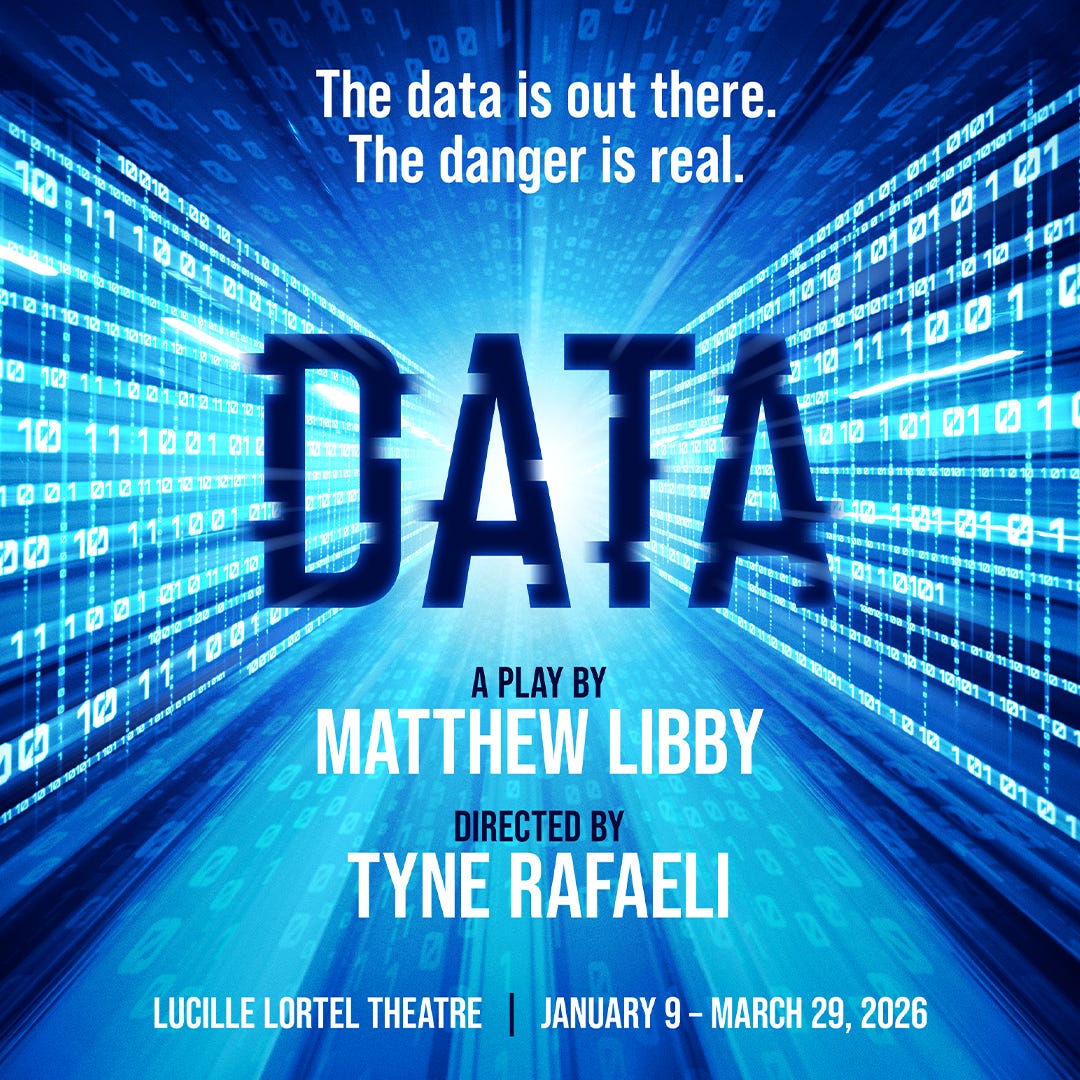
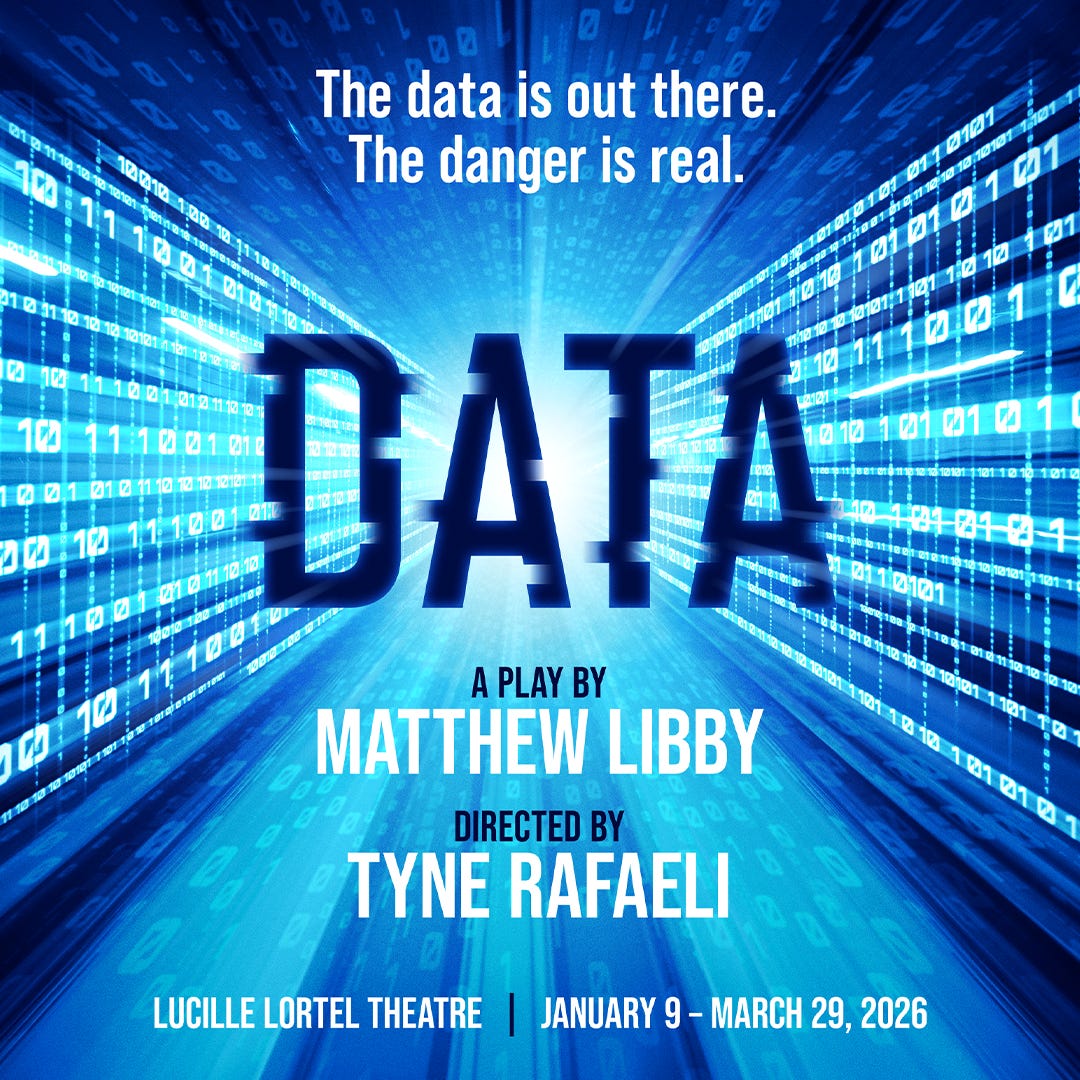
Data (2026) is a new play running off-Broadway right now at the Lucille Lortel Theatre. It has amassed some enthusiastic top-level reviews, but considerably more mixed consumer responses, and I think I understand why: it’s not done.
The concept is very timely: AI and data privacy. It’s allegedly a “pulse-pounding” thriller, though in my personal viewing experience it’s more of a “bass-pounding” sound design at all the transitions trying to force excitement where there is none. The idea is good and I can see why the pitch got it in the door. I would even go so far as to say the first section is pretty well written as of 2026. The problem, on the night that I saw it in March 2026, is that the ending is entirely missing.
A little digging on the Internet reveals that Data was heavily rewritten between it’s premiere in D.C. and it’s transfer to NYC, and was still being panic-rewritten every night through previews. For those unfamiliar with theatre, it is normal to make small edits until the “freeze,” which is a cutoff date at which the playwright and/or director agree to stop twiddling with it and let the poor actors work with a stationary script. It is professionally standard for this to be at least a week before opening, usually while tech is still going on. But as far as I can tell from audience discussion online: no freeze was ever enacted on Data even all after a paying audience was in the house. Someone else who saw it during previews said the ending they saw was so janky, the audience froze and was unsure if they should applaud or if it was over. The lights came up, the director came out on stage, and said “it’s okay to laugh.”
A couple weeks after that, when I saw it, the front half of it had developed into a recognizable three-act structure, setting up a conflict and proposed struggle for the protagonist, and then right as we turned into the third act where the protagonist makes a decisions to act... done. Over. Cut, house lights up. The play’s conclusion is simply and completely missing. All Checkhov’s rifles dropped. I would be more charitable towards this had it been structured in some kind of esoteric offbeat format, but the first 75% of the play cleaves so strongly to the beats of a standard three-act structure, it’s very noticeable when the playwright just... gives up.
As it is, the beginning is too long. There’s no intermission while being nearly two hours to only do the first 75% of a plot. They spend a lot of time talking about side plot topics with characters that are never resolved. I paid close attention to all the lengthy setups, trusting they would go somewhere, and they never did. I hate to say this, but I’ve seen more polished scripts in table reads. Regularly. It confuses me, because the same playwright won a fairly prestigious contest at Dartmouth for a different script... then again, the Neukom Award isn’t from Dartmouth’s theatre department. It’s from the computer science department to encourage people to write about the topic “what does it mean to be human in a computerized world?” Sort of a like a smaller, more specialized version of the Sloan Initiative.
If you look at how few submissions Sloan has received—2000 in the last fifteen years, comparable to what much smaller contests without restriction on topic receive in a single submission window—that tells you how few people write about science and technology in general, much less who write about computer science in particular. When you make the pool even smaller, as Neukom does, one wonders how competitive it can be in any given year. They don’t post their submission stats, but given how many rules Sloan has had to make about “sci-fi is not science” and “We welcome neuroscience, but plays about ‘psychology’ and ‘the humans condition’ do not qualify,” I can only imagine Neukom must also get a lot of long-stretch submissions about “well, the character saw something online once, so….”
They might have been overjoyed to get a truly on-topic submission, at all. This guy might be going on the strength of his niche pitch alone, and just not know how to write a play.
I’m glad he’s trying. I’m glad he’s getting productions. It’s absolutely normal for a show to not be fully baked in it’s first few mountings and for it to evolve over time. I just think it’s a little early for it to be off-Broadway. I think it needed at least one more regional production first and for someone to give him a 101 textbook on story structure and work through it with him. Data has potential and I want to like it. It’s just not all there yet.